Twenty-Six Defense is defined by our purpose, our people and the impact we make. Explore who we are, what we stand for and how we’re shaping what comes next.
About Twenty-Six Defense
Learn who we are, what we stand for, and where we are headed.
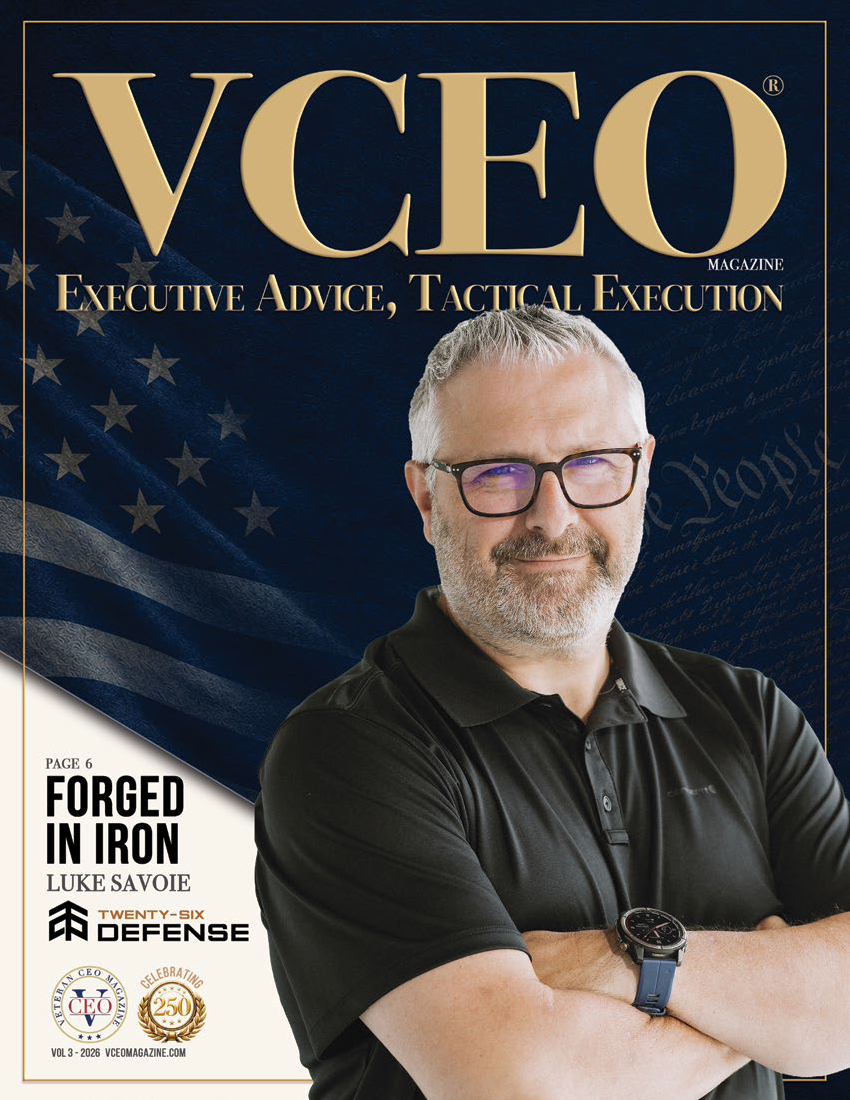
What does it mean to create an “iron” culture? Twenty-Six Defense President and CEO Luke Savoie has a bit of experience in this forge. As a U.S. Air Force special operations pilot who flew the AC-130WU Spooky II and the U-28A Draco, Luke flew critical missions where the outcome could mean life or death. These operations were so vital that when it was time for Luke to transition out of the military, he knew he needed a role that kept him close to the mission.
“You become addicted to the mission, so for me it became: how do you stay supporting what was, at the time, the most important mission in the nation?” Luke said during an interview with VCEO Magazine®.
Luke describes his own military transition as Surprising, Rewarding, Mission-Driven, Challenging, Fast and, notably, “No-Checklist.”
Moving from an environment where every procedure has an operating manual, and even the checklists have checklists, to one where none exists captures the essence of navigating military and civilian careers.
“Day one is day one,” Luke says, adding that in civilian careers, there are no training events like in the military that require months of qualification training beforehand. “You are immediately day one in the seat, and someone's asking you to sign a purchase order.”
Culture Shock: Life After the Military
Luke went into a startup straight out of the military, about 12 people, with more than half also being Veterans.
“Quickly, things can escalate to where everyone just thinks they're deployed and you're playing pranks or you're doing something like that,” Luke recalled a moment when military and HR culture collided. “I had an incident where someone played a prank, they created a mess, and I was like, okay, no one's leaving here until this is cleaned up.”
That’s when the HR lead pulled him aside and told him that, legally, he couldn’t make employees stay as they did in the military.
That was the clue-in moment when he realized things like additional duties outside of the normal day-to-day job description had to be handled with more consideration. He couldn’t just tell someone to take out the trash anymore if it was the bin in their office. He had to lean into telling people the “why they should care” reasons.
“The key thing to drive a business way beyond what just financial incentives do for employees is to link them to the mission.”
Luke also noted that one nearly universal trait in the Veteran community is a strong work ethic. “You don’t even understand that it's exceptional.”
Work Smarter, Not Harder
Over the course of Luke’s career, he moved from startups to scaling businesses that manage nearly 3,300 employees and generate nearly $2 billion in revenue. When asked what he would tell himself at the start of this journey, Luke stressed that he would tell himself to avoid the trap of micromanaging.
“You put a lot on your shoulders because you know you can personally follow through on it. You start to feel a little bit of guilt about putting that much work on other people.”
The lesson in delegation isn't just handing off tasks; it's also about decision-making power. The challenge is how the military creates multiple training situations throughout an entire organization that can simulate failure without real-world consequences. But in the civilian world, people rely on the people around them, and the consequences hit immediately.
“You have to delegate, and you have to learn how to trust.”
Luke also added that Veterans should be wary of feeling guilty if they’re not working 120 hours per week, noting it is a recipe for burnout. “I do not fall for the trap of making a bunch of busy work for people just so that you feel like your day is occupied.” Instead, Luke encourages people to ask the right questions and get answers that help them focus on what others miss.
Follow Your Gut
As Veterans navigate their postmilitary careers, the focus shifts from military to business. With this shift, Veterans may feel they lack the knowledge or background to make informed decisions. However, this is exactly why Luke says that an important lesson for Veterans to lean into is to “follow your gut.”
“We are taught to do a lot of subconscious processing,” Luke says, explaining that service members deal with imperfect information all the time and must make decisions within short windows. “Over the years, you have been taught that. You didn't know it, but you have been taught it. And every exercise or every training thing that you've done, every command appointment has told you to trust your gut.”
One example from Luke’s military service was a mission where he was flying an aircraft low on fuel and had to decide whether to return to station, even though the mission required him to keep eyes on an objective where he was the only one with a clear visual.
“It [the plane’s engines] probably was going to flame out in 30 seconds to a minute. I mean, it was that close.”
In that moment, Luke trusted his training and instincts, given the distance to the airfield and how long his aircraft could glide, to make a decision that maximized airborne time and let them return safely.
“That isn't an emotional call. It's a very calculated call. Math was involved. I didn't do it on the fly, but I kind of knew and could see and understand and made a good decision.”
When comparing his experience on a mission like this to the corporate world, Luke compared it to working with a lawyer by trade, whose role, by design, seeks perfect data and risks decision paralysis. “You need to trust your gut. Like you really need to learn how to do subconscious processing, deal with imperfect data, and make a decision.”
There Is No Spoon
An approach Luke learned in Air Force Special Operations and carried through his corporate leadership career is that “there is no spoon,” a reference to The Matrix, where Neo learns to surpass his perceived limitations. While operating manuals and standard operating procedures describe steps and processes, they are task-oriented; at the senior leadership level, the mindset shifts to something more strategic. With that shift, the focus can't be on reviewing every detail of every step.
“You get that from things like doing mission briefs, right? I can't sit there and spend three hours explaining to everyone what's going on.”
At one point in Luke’s corporate journey, he was brought onto a new team and told by the boss at the time, “I don’t know what the secret sauce is, but don’t mess it up.” Luke says he took this to heart because he knew there wasn’t a special piece of technology, policy or process making the difference in the organization.
“I was like, okay, what makes this place special? And I distilled it down to, I called it, there is no spoon,” Luke says. “The secret sauce is people and having a mindset that there isn't some magical thing we invented that makes it special. It is we who make it special.”
Luke also noted that with the right people, it's possible to unlock being “infected by the mission mindset and the problem-solving mindset.” Part of the problem-solving mindset is to always approach a problem by working backward from the answer, not working forward from the last problem.
Helping Veterans – The No Fail Missions
Twenty-Six Defense isn’t just a company name; 26 is the atomic number of iron, and the name reflects the company's and its employees' resilience.
One reason Luke came to Twenty-Six Defense to lead the business was its significant Veteran population. Twenty-Six Defense employs Veterans through SkillBridge and also prioritizes other issues that affect Veterans after service.
One health challenge Luke prioritizes is supporting Veterans through cancer treatment. Many Veterans serve in locations during their military service that increase their risk for cancer. Cancer treatment is also personal to Luke, who grew up in Flint, Michigan. His father passed away from renal carcinoma, a form of kidney cancer. His mother developed the same cancer less than two years later.
His own experience at Balad and Karshi-Khanabad (K2) gave Luke firsthand insight into the risks of increased toxic exposure. Luke shared that just a few months of exposure to conditions many Veterans faced downrange can manifest in cancers years later in life. Several of his military peers have battled non-Hodgkin lymphoma, a group of various blood cancers. Some have survived with treatment; others have passed away. One of those friends had developed cancer from burn pits, and Luke noted that you would never have known, based on the way many Veterans handle such challenges: alone.
“I remember when he was at the hospital on a work trip, and they had taken two bags of fluid out of the lining of his lungs, and he's doing a selfie in the ER, holding one of the bags of just fluid that they pulled out of him.” Luke shared, reflecting on his friend’s resilience, “[he] had a smile throughout the entirety of the process.”
Luke prioritizes supporting organizations that help treat patients with cancer, like Blood Cancer United, because he wants to help prevent other stories like that of his friend from ending the way it did.
“I want to prevent the problem from the beginning, and that’s why we are focused on left of bang.”
The story of one Veteran not sharing details about lingering trauma after service is not a standalone issue.
Luke took time to stress the importance of multiple issues that can be dangerous to Veterans after service, including chronic pain and isolation.
“The origin of the trauma and stuff that is out there, I will tell you, the solution to most of this is not letting people be alone,” Luke said, stressing the importance of employment to give people a sense of camaraderie. “The quickest way and the most sure way to do that is to give them purpose and meaning when you bring them to work.”
Editor's note: For any Veteran in crisis, or person concerned about a Veteran in crisis, the Veterans Crisis Line is available. Veterans do not have to be enrolled in the VA for crisis support. Dial 988 then press 1 or visit Veterancrisisline.net
The Next Chapter – Know Your Worth
Advice on Salaries for Veterans:
As Luke concluded his time with VCEO Magazine®, he offered advice and a warning to Veterans regarding their salaries in the civilian market.
“Don’t sell yourself short. You’re worth more.” Luke warns. “You do not want to set your salary expectations based on what the military paid you.”
The disadvantage of having had military service when entering the civilian market is that military pay is public record. When you include your branch, years of service, rank and duty stations on your resume, a quick internet search can pinpoint your paycheck to the cent.
There's a reason why I went to work in the startup world versus in one of the big six in the defense industry, because they just looked at your pay scale and went, this is the bump we're going to give you because we know what you make today.”
Advice On Finding Connections After Service:
You can find people with the same mindset outside of the military.
“It is possible to find the same focus and the same meaning out here as it was on the inside [of the military],” Luke says. “I found that again on the outside… you find a group of people, and they adopt and understand that, and you have a culture of a team that is that way. You can find it. It's out there.”